Procedural Wood
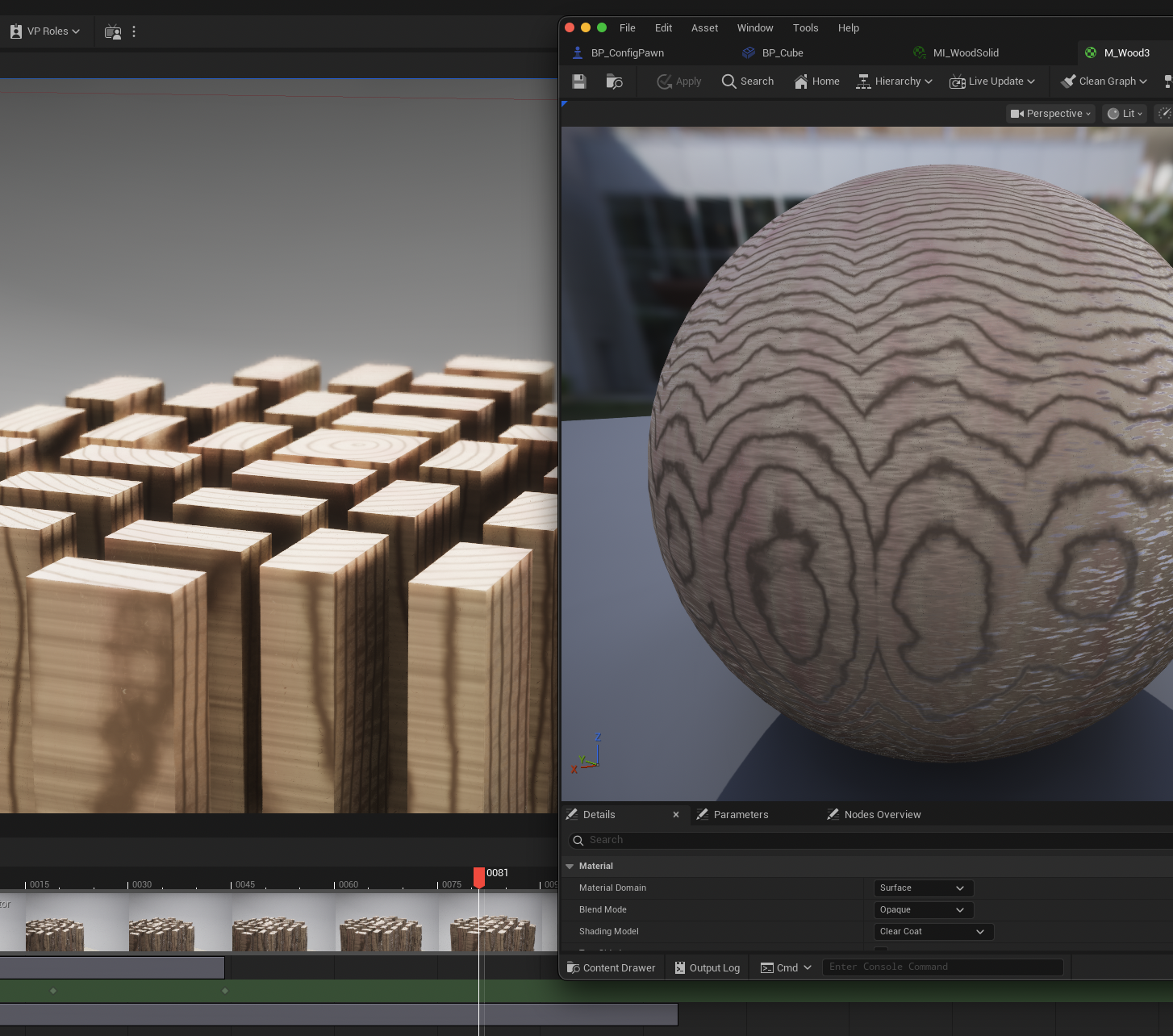
The Project
I find UV-mapping interesting but sometimes I think, wouldn't it be cooler if we just had a three dimensional material that you could cut and shape while retaining the inside fibres, color shapes and textures? This material does just that, a wood material with fibres, grains and wood rings. The idea came while I was creating my guitar configurator, I wanted the wood of the body and neck to look realistic.
Challenges & Solutions
At first, how are planks from a tree cut? What determines the wooden patterns and how do I create layers of fibres and grains using noise? I first started in Substance Designer (a school assignment) where I realised the procedural process is the way to go but, at the same time this software will only produce twodimensional images which can be used as UV's which is what I was trying to avoid in the first place. Second attempt I made in Blender after finding a good tutorial on how to build materials procedurally. This led to a better result but my intention was to use this in Unreal and I wanted an extra quality to my wood: chatoyancy. This is an effect where the looking angle and light make the wood fibres shift. If you have seen a violin with a striped maple top or a Gibson 1959 Les Paul, you might have seen chatoyancy. Since light conditions in material are very different in Blender and in Unreal, I had to start over.
The node tree starts with location and offsets. These determines where in the tree the plank is cut which sets the wood pattern. These go to noises that are manipulated along the xyz-axis to be the base for how colors, normals and chatoyancy behave. Rings, scale, grain intensity are parameters that can be tweaked in material instances. Next steps in this material is adding parameters for color, surface wear and easier wood rotation.